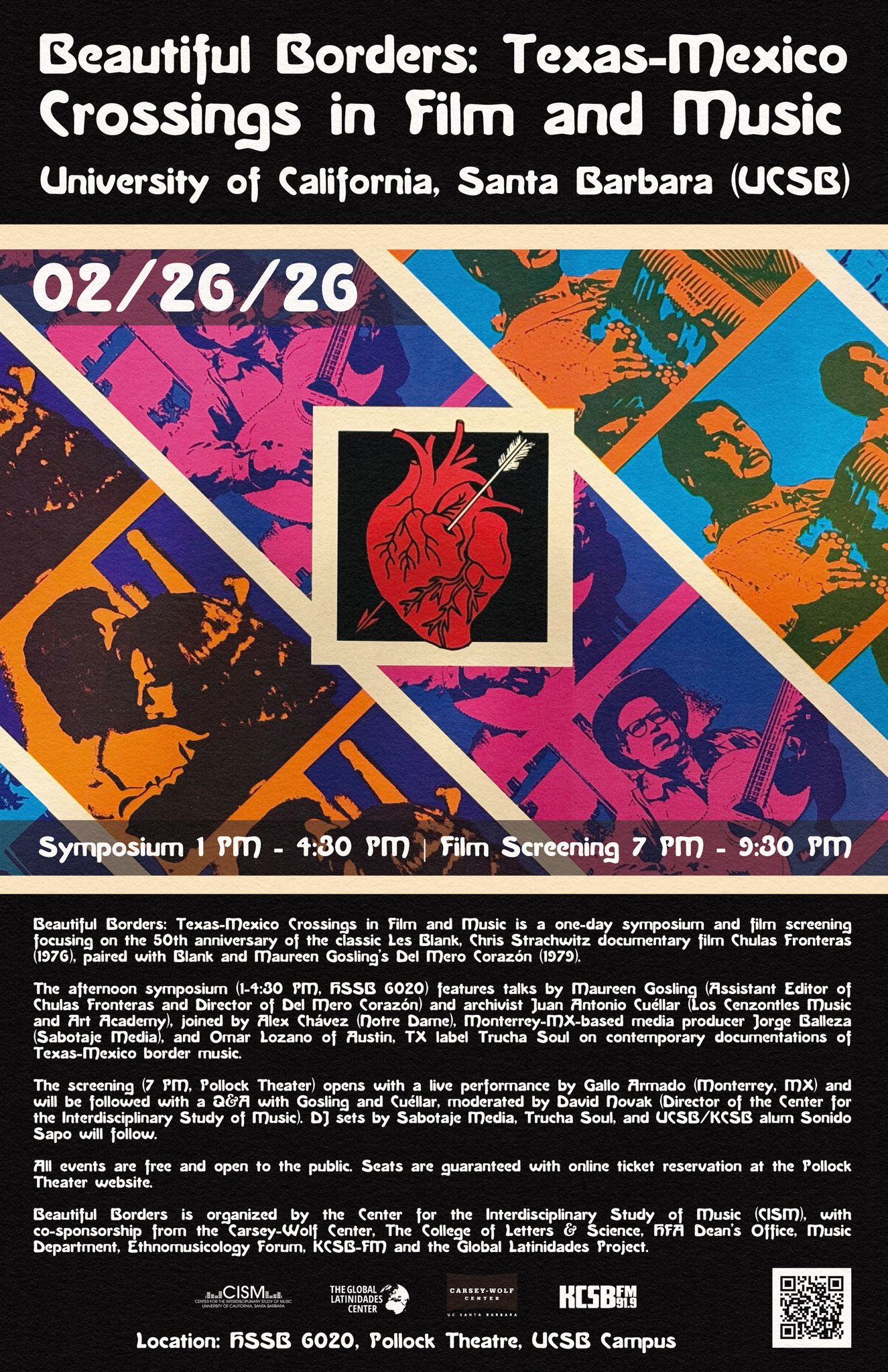
Event Date:
Beautiful Borders: Texas-Mexico Crossings in Film and Music is a one-day symposium and film screening focusing on the unique role of music in Texas-Mexico border culture, to be held on February 26, 2026 on the campus of the University of California, Santa Barbara. The event is centered in a public screening of the 50th anniversary 4K restoration of the Les Blank/Chris Strachwitz film Chulas Fronteras (1976), paired with Del Mero Corazón (1979) at the Pollock Theater. The screening will be followed with a Q&A with Maureen Gosling (Assistant Editor of Chulas Fronteras and Director of Del Mero Corazón) and Juan Antonio Cuéllar (Archivist at Los Cenzontles Music and Art Academy), moderated by David Novak (Director of the Center for the Interdisciplinary Study of Music). The film screening is preceded by an afternoon symposium during which Gosling and Cuéllar will be joined by Alex Chávez (musician/ anthropologist at Notre Dame and author of the award-winning book Sounds of Crossing), as well as a joint presentation by Monterrey-MX-based archivist and media producer Jorge Balleza of Sabotaje Media with Omar Lozano of Austin, TX label Trucha Soul on contemporary documentations of Texas-Mexico border music. The screening will be preceded by a performance of corridos by Gallo Armado (Monterrey, MX), with DJ sets by Balleza, Lozano and UCSB/KCSB alum Eduardo Camacho (Sonido Sapo) before and after the film screening. All events are free and open to the public. Seats are guaranteed with online ticket reservation at the Pollock Theater website.
Beautiful Borders is organized by the Center for the Interdisciplinary Study of Music (CISM), with cosponsorship from the Carsey-Wolf Center, The College of Letters & Science, HFA Dean’s Office, Music Department, Ethnomusicology Forum, KCSB-FM, the Global Latinidades Project and Latino/a Studies
SCHEDULE
Symposium
1-4:30pm
IHC McCune Conference Room 6020 HSSB
Before Chulas Fronteras and Del Mero Corazón
Juan Antonio Cuéllar (Los Cenzontles Music and Art Academy)
This talk will center and contextualize Chulas Fronteras and Del Mero Corazón through musical knowledge gained from years working alongside Chris Strachwitz and digitizing the Arhoolie Frontera Collection. Drawing from firsthand experience digitizing, cataloging, and curating thousands of Mexican and Mexican American recordings, I will situate the musicians featured in the films within longer traditions of borderlands sound, corridos, conjuntos, polkas, rancheras, and locally rooted styles that circulated through records, radio, dances, and migrant networks long before they appeared on screen. This presentation will trace how this music connects to earlier commercial recordings, regional performance practices, and lyrical themes. Attention is given to instrumentation, vocal style, repertory, and the social worlds these musicians live in, as they are poetically reflected in Chulas Fronteras and Del Mero Corazón.
Behind the Scenes: Chulas Fronteras and Del Mero Corazón
Maureen Gosling (Brazos Films)
Gosling presents a “behind the scenes” look at the making of Chulas Fronteras on the 50th anniversary of its release. Arhoolie Records producer Chris Strachwitz had long admired documentary filmmaker Les Blank, whose films on Blues, Cajun and Zydeco were experiential and heart-felt celebrations of music, food and culture. Strachwitz convinced Blank to join him to make a film on the Texas-Mexican border musics and cultural traditions that were his passion, which had never before been documented. In 1974, with Blank on camera and Strachwitz doing sound, they filmed in South Texas, along with Interpreter/Second Camera/Camera Assistant, Bruce “Pacho” Lane. Maureen Gosling joined the team as Assistant Editor in 1975 when editing began in Berkeley, CA, working with Co-Filmmaker Prof. Guillermo Hernández on translations. After Chulas Fronteras was released in 1976, Gosling revisited other priceless material shot by Blank and Strachwitz to create the short Del Mero Corazón, released in 1979. Now that her colleagues are no longer with us, Gosling holds the stories of the making of the films, the significant impact they have had and what they have meant in her own life.
Nuevas Chulas Fronteras: Tracing Contemporary Sounds of the Tex-Mex Borderlands
Jorge Balleza (Sabotaje Media), Omar Lozano (Trucha Soul Records)
Fifty years after Les Blank and Chris Strachwitz's classic Chulas Fronteras documented the musicians and cultural identities of the Texas-Mexico borderlands for the first time on film, Jorge Balleza and Omar Lozano share ongoing archival work from the contemporary music movements that are shaping the region's sound and identity. Where Blank and Strachwitz captured the early norteño and conjunto traditions that defined mid-20th century border culture—accordion-driven corridos and the working-class experiences —Balleza and Lozano turn their focus toward the border region in a state of sonic and cultural transformation. From viral cumbia wepa dances emerging from the hot desert of Coahuila, Texas "Screwmbia" that fuses gulf coast chopped-and-screwed hip-hop with techno-cumbia rhythms, underground Tribal Mexican club movements that layer ancestral instrumentation with experimental electronic sounds, to the new wave of corridos of territorial resistance and activism, this talk will present specialized archival work focused on a bold new generation of “beautiful borders.”
A Regional Sound: Mexican Texas and the Creative Economies of Música Tejana
Alex E. Chávez (Notre Dame)
Chávez draws on his Permian Basin roots to reflect on the creative economies and cultural geographies of ethnic-Mexican music in the 1980s/90s in West Texas. Brought up in a Mexican migrant musical family, he witnessed first-hand the material and cultural work that transformed leisure and labor spaces into crucial sites of congregation amid economic uncertainties associated with a precarious border politics and music business. From ballroom dances, church festivals, family fiestas, and country fairs, these vernacular spaces of music-making highlight the cultural and market contradictions of U.S.-Mexico neoliberal restructurings at the time and their implications for immigration and the symbolic construction of ethnic-Mexican musical regional styles and identities.
Screening
Pollock Theater - 7PM
Chulas Fronteras (Blank/Strachwitz 1976) & Del Mero Corazón (Blank/Gosling 1979)
The symposium concludes with a special fiftieth anniversary screening of Chulas Fronteras (1976), newly restored in 4K and paired with the 1979 short Del Mero Corazón. Directed by Les Blank and Chris Strachwitz, Chulas Fronteras celebrates the famed Mexican-American musicians of the borderlands, the migrant farming communities from which they come, the strong family bonds of Tejanos, and the social protest ethos inscribed in their music. From joyous, lively dance tunes to soulful, political work songs, musica norteña fuses traditional Mexican harmonies with central European dancehall rhythms. The film brims with tender affection for its subjects, the vitality of their marvelous music, and the generosity of spirit that they show in the face of hardship. Del Mero Corazón (Straight from the Heart), directed by Les Blank and Maureen Gosling, is a lyrical journey through the heart of Chicano culture as reflected in the love songs of the conjunto tejano and musica norteña traditions. The film was constructed from outtakes from Chulas Fronteras and additional footage shot in California.
A performance by corrido singer-songwriter Gallo Armado (Fernando Ríos) will precede the screenings of Chulas Fronteras and Del Mero Corazón. Following the screening, filmmaker Maureen Gosling (editor and sound recordist of Chulas Fronteras and co-director of Del Mero Corazón) and library science doctoral student Juan Antonio Cuéllar (longtime archivist of Arhoolie Records’ Frontera Collection) will join moderator David Novak (Director of the Center for the Interdisciplinary Study of Music, UCSB) for a discussion of the two films.
The screening is bookended by DJ sets of contemporary and historical border music by Sonido Sabotaje, Trucha Soul, and KCSB alumnus Sonido Sapo in the HSSB courtyard next to the Pollock Theater (weather permitting).
PARTICIPANTS
Jorge G. Balleza (also known as Sonido Sabotaje) is a multidisciplinary artist and cultural documentarian from Monterrey, Nuevo León, with ancestral roots spanning Sonora and Coahuila. His practice centers around crafting audiovisual remixes as immersive tools for understanding how sound and underground movements shape politics, memory, and identity. As a key figure of Monterrey's underground Rebajado MX parties, Balleza's work is rooted in the city's kolombia regia tradition and the aesthetics of la cultura rebajada—the slowed-down, bass-heavy subculture of northern Mexico and border region. As cofounder of a core member of Sabotaje Media, Balleza has built a new transmedia platform that maps the intersection of politics, music, and culture with a special lens on the global cumbia diaspora and its protagonists.
Scholar-artist-producer, Alex E. Chávez is Associate Professor of Anthropology at the University of Notre Dame, where he is also a Faculty Fellow of the Institute for Latino Studies. He is the author of the multi-award-winning book Sounds of Crossing: Music, Migration, and the Aural Poetics of Huapango Arribeño (Duke University Press, 2017)—recipient of the Alan Merriam Prize from the Society for Ethnomusicology (2018). He extended the reach of this research in collaboration with the Smithsonian Institute, producing a Smithsonian Folkways Recordings album featuring the legendary poet Guillermo Velázquez, who in 2024 was awarded the coveted National Prize for Arts and Literature by Mexico’s Federal Ministry of Culture. Chávez is widely published in academic journals—including American Anthropologist, Journal of Linguistic Anthropology, Journal of American Folklore, Latino Studies, and Latin American Music Review—and he has recorded and toured with his own music projects, composed documentary scores for Emmy Award-winning films, and collaborated with Grammy Award-winning and Grammy Award-nominated artists. In 2024, he released his solo debut album, Sonorous Present (Artivist Entertainment) produced by Grammy Award-winning artist Quetzal Flores. Of the album, Rolling Stone says, “His debut album, Sonorous Present, goes deep, offering an intimate reflection of borderlands, memory, and both literal and figurative passages.” A Fellow of the National Endowment for the Humanities, the National Science Foundation, and the Ford Foundation, in 2020 he was named one of ten Mellon Emerging Faculty Leaders by the Institute for Citizens and Scholars. He currently serves on the National Board of Trustees of the Recording Academy (Grammys).
Juan Antonio Cuéllar was born in Los Caños, Aguascalientes, Mexico, raised in Santa Cruz, California, and later moved to San Francisco. After working in the city’s hospitality industry, he pursued music touring and playing valve trombone with the San Francisco, based bilingual punk band La Plebe. During this time, Cuellar worked at the Arhoolie Foundation as head digitizing engineer for the Strachwitz Frontera Collection, the largest repository of commercially and independently recorded Spanish-language music. Over two decades, Cuéllar digitized more than 160,000 recordings and later helped curate the collection, processing and cataloging hundreds of photographs, videos, and printed materials to expand public access. His work centers on Mexican and Mexican American vernacular music and the role of archives as spaces for community memory. He has contributed to oral history projects and digital exhibitions, including Historias de la Alondra and Rumbo a California. Cuéllar is pursuing a master’s degree in library and information science at San José State University and is the Archivist and Digital Asset Manager at The Los Cenzontles Music and Art Academy in San Pablo, California.
Gallo Armado is the musical project of Fernando Ríos, a corrido artist and songwriter from Monterrey, Nuevo León. In 2025, Ríos made history as the first corrido artist to win Nuevo Talento Nuevo León, the region's prestigious talent competition, with his composition "El Corrido del Aire"—a song advocating for environmental protection for the air and rivers in Monterrey, demonstrating that the new wave of corridos could serve as storytelling vehicles for current socially conscious themes. His songwriting centers the experiences of working-class communities—from orange vendors in Montemorelos, to mothers searching for disappeared loved ones and environmental and territorial activism. Currently working on his debut album La Ciudad es Nuestra (“The City Is Ours”), crowdfunded by family, friends, and supporters, as well as an upcoming 7” single release with Trucha Soul and Sabotaje Media, Gallo Armado represents a new generation of musician that is redefining regional Mexican music, offering strong counter-narratives of emerging corrido music with stories of dignity, resistance, and everyday survival.
Filmmaker Maureen Gosling has directed, produced, edited, recorded sound and distributed documentaries since 1972. A graduate of the University of Michigan (BA, Social Anthropology), she began as a sound recordist with Les Blank, beginning a 20-year collaboration in which they made over 20 films, including BURDEN OF DREAMS (Co-filmmaker, Editor, Sound) British Academy Award – Best Documentary, 1982; I WENT TO THE DANCE: The Cajun and Zydeco Music of Louisiana (Co-Filmmaker, Editor); and more. Gosling’s feature documentary, BLOSSOMS OF FIRE (2000), celebrates the Isthmus Zapotecs of southern Oaxaca, Mexico, broadcast on HBO Latino. Her more recent films as director/producer/editor include the feature-length docs, THE 9 LIVES OF BARBARA DANE (2023) on jazz/blues/folk singer/activist Barbara Dane, and THIS AIN’T NO MOUSE MUSIC! (2013, with Chris Simon) on roots music record producer Chris Strachwitz, which premiered at SXSW. She is Director/Editor on DEL MERO CORAZON and Assistant Editor/Translator on CHULAS FRONTERAS.
Omar Lozano is an El Paso-raised, Austin-based DJ, producer, photographer and founder of Trucha Soul Records, a label dedicated to documenting and amplifying contemporary Texas-Mexico border music. Trucha Soul has released compilations and original works that highlight norteño, cumbia, and experimental Tex-Mex fusions. As an extension of the label, Omar operates Sonido Trucha Soul Sound System, a traditional Mexico City-style sonidero street sound system, made in collaboration with legendary sound system builder from CDMX, Sonido El Pato. It is an inclusive, DIY modular system, powered by cumbia, resistance and community. As a photographer and creative director, he has documented frontera street life and subcultural movements around the world. His work and mixes have been featured on Rolling Stone, Lot Radio, Radio Nopal, Aire Libre FM, Red Bulletin and Virgil Abloh’s Televised Radio.
David Novak is Associate Professor in Music and Director of the Center for the Interdisciplinary Study of Music at UCSB. He is the author of Tapeheads: A Living History of the Cassette in Indonesia (Elevation 2025) and co-editor (with Matt Sakakeeny) of Keywords in Sound (Duke 2015); his award-winning book Japanoise: Music at the Edge of Circulation (Duke 2013) has been translated into five languages. His current project, entitled Diggers: An Archival Counterhistory of Popular Music, explores the globalization of music through networks of record and cassette collectors, informal sound archives, reissue labels and media digitization projects in the Global South.
Sonido Sapo (Eduardo Camacho) is a Los-Angeles based musician and DJ. He returns to campus as an alumnus both of UCSB and KCSB-FM to perform a set of border music and cumbia rebajadas remixes.